A national, student-focused electric motorsport that turns physics class into a competition — and competition into careers.
Why Efficiency Matters
Efficiency isn't glamorous on the surface — but it's the engine behind every company that changed the world.
“Use less energy” doesn’t sound thrilling. Look closer. SpaceX lands rockets to reuse every gram of fuel. Tesla rebuilt the car around the electron. Toyota grew an empire on doing more with less. The biggest breakthroughs of our era are efficiency stories — and that’s exactly the problem Electrathon students fall in love with.
Squeeze more distance from a fixed charge and you’re solving the same challenge every great engineering company is racing to crack. Efficiency drives the entire economy — the power grid, the supply chain, the chip in your phone. Master it young, and doors open. This is a direct on-ramp to real engineering careers.
SpaceX
Tesla
Toyota
All built on relentless efficiency.
Drives the economy
Energy, logistics and computing all run on efficiency — a multi-trillion-dollar discipline hiding in plain sight.
Where breakthroughs happen
Reusable rockets, electric cars, lean manufacturing — every leap forward is an efficiency story at heart.
A path to careers
Electrathon connects students directly to engineering pathways — and to employers who prize exactly this skill.
What is Electrathon?
One driver. One hour. One battery.
Teams design and build a lightweight, single-seat electric vehicle. On race day, every car runs the same format: one hour on a closed course, powered by a limited battery allowance. The car that completes the most laps wins.
Because energy is capped, winning is about engineering efficiency and race strategy — aerodynamics, weight, rolling resistance, and how the driver manages power — not raw horsepower. It’s the most educational form of motorsport in the country.
Electric car on track
The Numbers
The most efficient cars on the road — built by teenagers
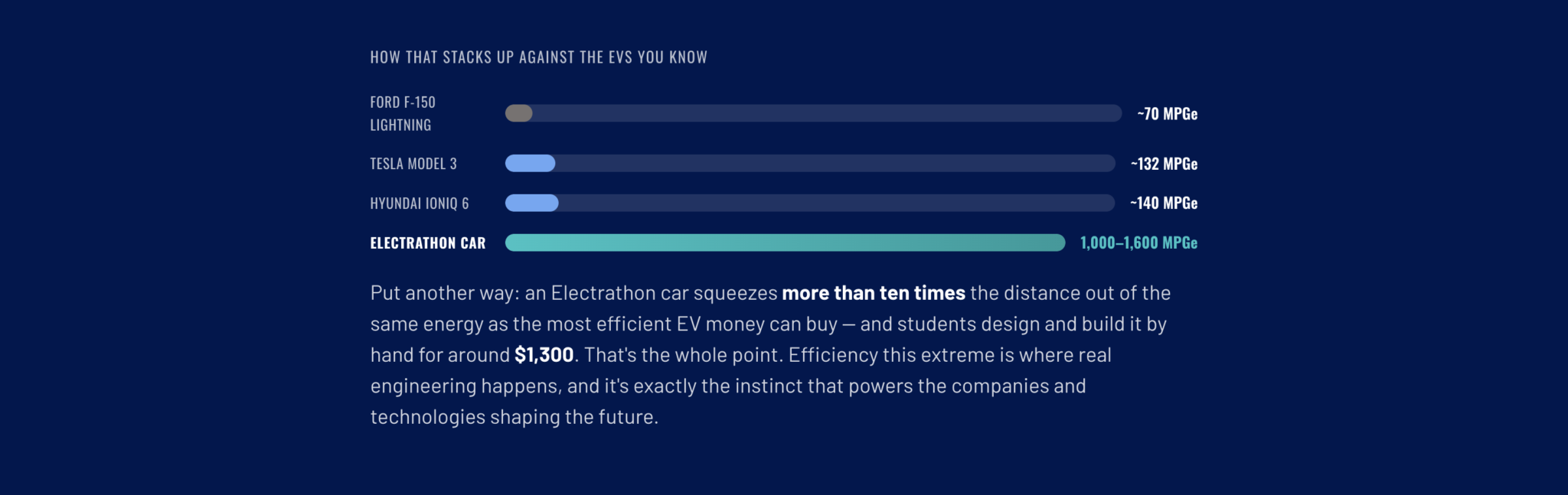
Electrathon cars are scored in MPGe — miles per gallon of gasoline equivalent. The results don’t just beat the best EVs on sale. They lap them.
1,000
Fleet average
1,600
Top performers
The Format
How a race works
1
Tech inspection
Every car is checked for safety and rules compliance — battery limits, braking, roll protection.
2
Green flag
All cars launch together. The clock starts and runs for a full 60 minutes.
3
Manage the energy
Teams balance speed against battery life. Driver swaps and pit strategy matter.
4
Most laps wins
When the hour ends, total distance decides the standings in each class.
Who Competes
Two classes, one paddock
Students never age out of the sport — they graduate into it.
High School Class
For school teams
Students in grades 9–12 build and race under an advisor. The on-ramp to the sport, with rules and support designed for first-time builders.
Advisor-led, classroom friendly
Curriculum & grant resources
Regional events near you
Open Class
For everyone else
Colleges, clubs, alumni and adult builders. Fewer restrictions, more experimentation — the proving ground for advanced engineering.
Keeps alumni in the sport
Advanced & experimental builds
Builds the community pipeline
People Behind The Sport
Bob Franz
A longtime champion of hands-on engineering education and student electric-vehicle racing, Bob Franz has dedicated his work to giving young people a real, affordable path into STEM through motorsport.
His advocacy for accessible, student-built electric racing reflects everything Electrathon America stands for — curiosity, craftsmanship, and the belief that the best way to learn engineering is to build something and race it.